Why Doorways Matter in Stage Stories
Why doorways matter in stage stories: see how a threshold directs attention, divides dramatic space and turns an ordinary entrance into a story event.
Why do doorways matter in stage stories? A character can cross an otherwise bare stage and change the scene, but a doorway gives the audience a precise place to watch, a boundary to read and a reason to wonder who might arrive next. Its power comes not from the timber or paint, but from how a performance makes a threshold mean something.
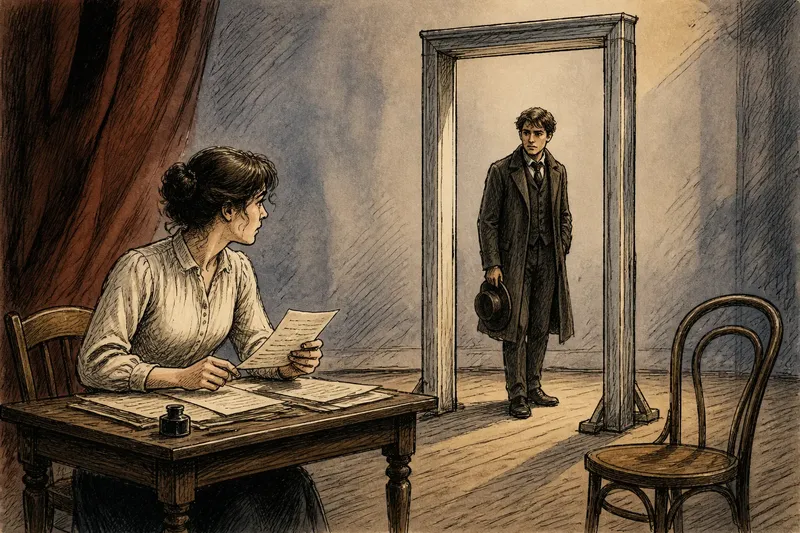
Imagine a small touring production set in a lodging house. The stage has a table, two chairs and one freestanding doorframe, with no wall attached. Mara, a clerk, is waiting for her brother, who has promised to bring a letter that could clear her name. The audience knows the letter exists; Mara does not know whether he has it. That single frame can organise the whole scene without adding another room.
A doorway gives the audience a fixed point
At the scene’s start, the frame stands at stage left. Mara sits at the table, facing it more often than she admits. The director has placed the table at an angle, so a person entering through the frame will be visible to the audience before Mara turns. That small arrangement creates dramatic irony: the audience can see an arrival coming while the character remains occupied with her papers.
The doorway also gives the actor a repeatable route. Mara’s brother enters, pauses on the threshold, then steps inside. The pause matters. He has crossed into the room physically, but his hesitation shows that he has not yet decided how much to tell her. A doorway can make an invisible change of mind legible because the performer can hold still at the point where action is expected.
In this invented situation, the frame is not a realistic piece of architecture. It has no working latch and does not lead to a built room. Its usefulness lies in the audience’s shared understanding: people pass through openings, and crossing one often means entering a different social or emotional space.
Stage entrances have changed with theatrical space
The doorway has no single origin or fixed theatrical meaning. Performers have used openings, curtains, wings and imagined thresholds in many kinds of theatre, while the buildings and conventions around them have changed. In a public playhouse, an actor might arrive from a side entrance known to the audience as a route from an unseen street. In a room-based performance, the audience may sit close enough to see a performer enter through an actual door.
Different stage arrangements make the same threshold behave differently. A proscenium stage frames the action like a picture, so a doorway within the set can create a smaller frame inside the larger one. In a thrust or arena arrangement, the audience sees the action from several directions; a doorway may need a clear silhouette or a distinctive sound so that people around the space can register the entrance.
Minimal staging can make the threshold more flexible. A bare frame can suggest a bedroom in one scene, a courthouse in the next, or simply a boundary that the performers agree to respect. The audience does not need a complete wall to understand the convention, provided the actors use the opening consistently. A realistic door, by contrast, can supply practical business: a knock, a locked entrance, a struggle to leave. Each approach offers different expressive tools.
The frame turns a room into a place with rules
For Mara, the doorway marks the edge of private space. Her brother knows he is expected, but he stops outside until she invites him in. That choice establishes their relationship before either explains it. If he barges through, the same entrance becomes an intrusion. The threshold lets the audience read permission, rank and intimacy through movement rather than exposition.
Now suppose the production shifts the frame from stage left to the centre during a brief scene change. When Mara later stands with one foot on either side, the audience can read her as caught between staying in the room and escaping its pressure. Nothing in the set has to announce this conflict. The actor’s position supplies the image, and the open frame gives it a visible edge.
A doorway can also divide what the audience sees from what it merely hears. The brother might step beyond the frame to speak with someone unseen, leaving Mara alone onstage. His voice from the other side keeps him present while the opening makes his absence visible. If the voice stops, the audience has a reason to attend to the silence and to Mara’s reaction.
A planned entrance can control suspense and pace
In the lodging-house scene, the brother first appears without the promised letter. He says it is still outside, then leaves through the frame. Mara does not follow. The audience watches the opening, waiting for his return, while her attention shifts between the door and the table. The doorway has become a promise of future action, but the delay gives the character room to reveal fear.
When he re-enters, he carries the letter visibly, though he does not hand it over. The audience’s attention moves from the opening to the object. This is a simple sequence of stage pictures: an empty threshold, an arrival, a departure, then a return with new information. Each crossing changes what the audience expects, so the frame helps the scene keep its shape.
Not every entrance needs to be surprising. A familiar character can cross at a steady pace to restore the scene’s rhythm after a pause. A hurried entrance can interrupt a quiet exchange; a careful one can stretch anticipation. The writer’s cue, the actor’s timing and the director’s placement all contribute. The doorway is a point of coordination, not a suspense machine on its own.
Small choices make a stage doorway readable
For the imagined production, the director and writer can make a few clear decisions:
- Decide what lies beyond the frame. Is it a street, another room, or an undefined space? Consistent use helps the audience understand where a character has gone.
- Give each crossing a purpose. An entrance might bring news, claim space or interrupt; an exit might avoid a question, create a pause or leave someone exposed.
- Set the audience’s sightline. Choose where a character pauses so the entrance can be seen from the seating arrangement.
- Make the threshold’s social rule clear. A knock, invitation or refusal can show who has the right to enter without a speech explaining it.
- Vary the pace deliberately. A brisk crossing and a hesitant one should not feel interchangeable if the scene depends on their different meanings.
- Check what the frame can safely support. If performers touch or move a prop door, follow the venue’s and maker’s directions for its use.
These decisions need not be discussed as a rigid system. They are prompts for asking whether the audience can follow the action and whether a crossing changes the scene. If a character enters, leaves and returns without altering attention, knowledge or relationships, one of those movements may not be doing useful dramatic work.
What should a writer ask about a stage doorway?
Does a doorway need a real door?
No. An opening suggested by a frame, a gap in a curtain or an actor’s established route may be enough. A working door is useful when the action depends on knocking, shutting, locking or the sound of someone arriving.
How can an entrance feel important without a surprise?
Give the crossing a consequence: the entrant changes who controls the room, interrupts a decision or brings an object into view. The audience may expect the person and still care about the manner of arrival.
Can one doorway stand for several locations?
Yes, if the performance makes each use understandable through context, acting and the objects around it. A frame that means “outside” in one scene can mark a different boundary later, but an unexplained change may confuse the audience.
What if a character never crosses the threshold?
That restraint can become the action. A character who waits outside, refuses an invitation or watches from the opening may reveal a boundary more clearly than one who enters.
The threshold earns its place through consequence
In the invented lodging-house scene, the doorway has helped the audience track attention, private space and the brother’s uncertain movements. The final crossing settles the scene: he steps inside, gives Mara the letter, and stays instead of withdrawing again. The frame has not supplied the answer to her problem, but it has made the change between avoidance and engagement visible.
When considering why doorways matter in stage stories, ask what changes at the instant of crossing. If the answer concerns access, attention, knowledge or a relationship, the threshold is doing more than decorating the set. If nothing changes, a different route—or no entrance at all—may tell the story more clearly.